

Subject Guides Clayton
Introduction:
Welcome to the 2026 Subject Overview! Here, you will find brief reviews of the full range of economic units on offer at Monash Clayton, along with information on the pathways for studying economics. We hope that this will help you navigate and maximise your economics studies at Monash.
Help us improve the Subject Overview:
We’re always looking to expand upon these reviews and keep them up-to-date. If you have completed any of these units recently, we would love for you to contribute to our Subject Overview.
If you would like to write a review for any unit(s), please contact us at essa@monashclubs.org.
Acknowledgment and Disclaimer
To create this subject overview, we’ve asked economics students at Monash University to share their experiences. We’d like to thank them for contributing their time and effort to do so.
This Subject Overview is the work of ESSA Monash Clayton and not of Monash University. It is not intended to replace the Monash University Handbook, which should be consulted for official information about each unit. The handbook can be found here: handbook.monash.edu.
This Subject Overview also reflects students’ experiences of economics units across various years. As such, this overview may not fully reflect the opinions of others who also took these units.
Bachelor of Commerce (Economics) at Monash Clayton
To complete a major in Economics under the Bachelor of Commerce, you will need to:
- Complete four core units
- ECC1000, ECC1100, ECC2000, ECC2010
- Complete an additional four economics units which are offered at the Clayton campus
- At least three of these units must be level three units (this means that the unit code should look like ECC3XXX)
It’s important to remember that you should follow the handbook from the year in which you started your course. The 2026 Subject Overview provides information consistent with the 2026 Economics major, which is the latest version available.
It is very important that continuing students consult the handbook for the year they commenced their course to confirm their major requirements. The handbook can be found at handbook.monash.edu.
ESSA’s 2026 Subject Overview does not constitute course advice. If you are unsure about your course progression or unit selection, please submit a Course Advice Request form or contact Monash Connect.
Progression Streams
Some units have prerequisites, which should be taken into account when planning your course progression. For your convenience, we have compiled the progression streams for the full range of economics units below:
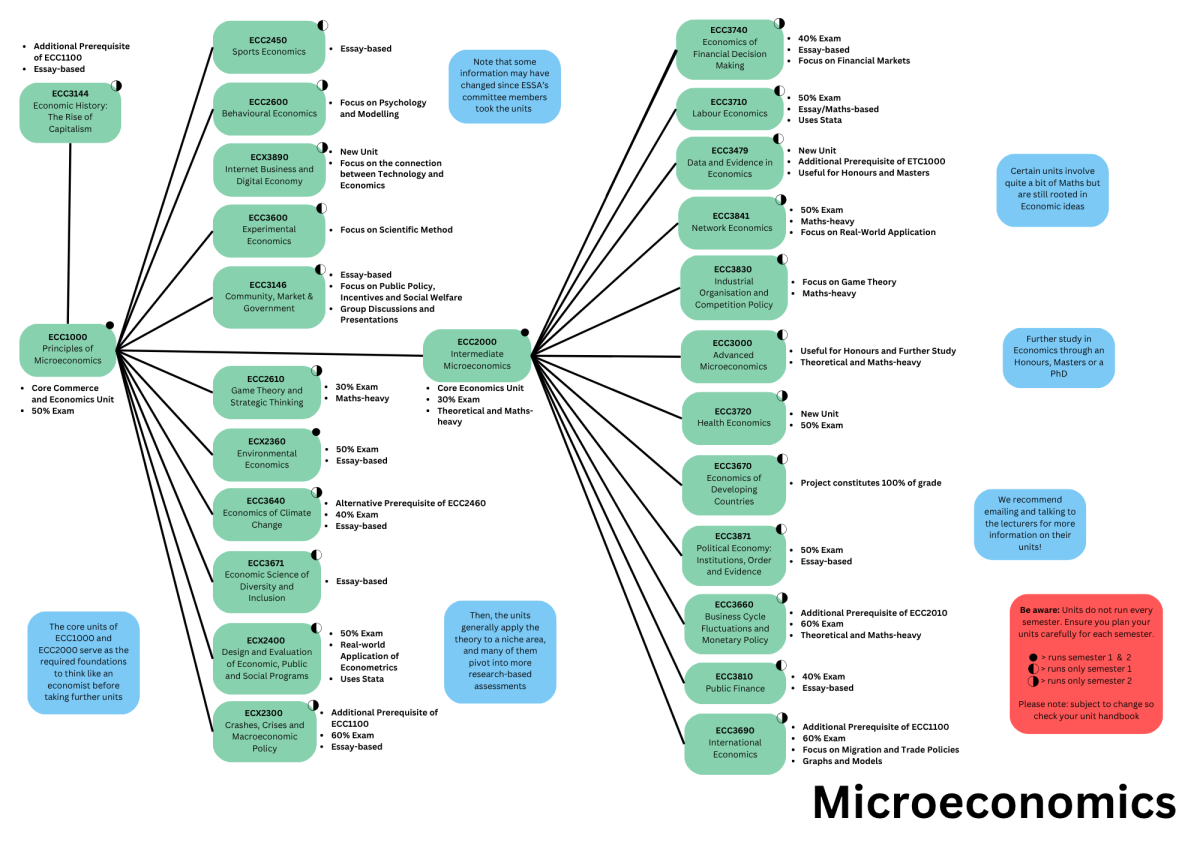
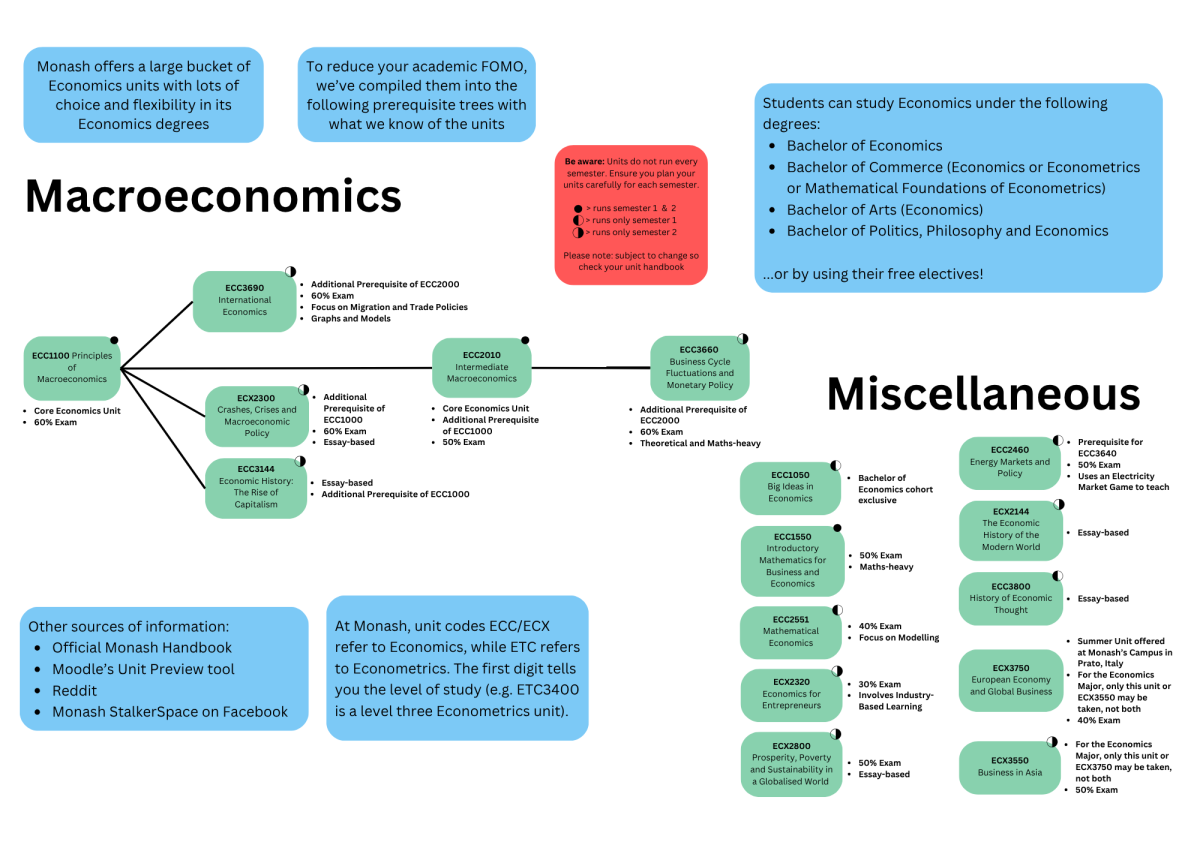
The Four Core Economics Units
Additional Economics Units (Clayton)
Level 1 Semester 1
Level 3 Semester 1
Level 3 Semester 2
Summer Semester
Economics Honours
What is Economics Honours?
The Economics Honours program is an additional year of study you can undertake after completing your bachelor’s degree. It is an opportunity for you to dive deeper into economics beyond what you’ve learnt in your bachelor’s degree. The course consists of two main components:
- Coursework: Each semester, you will complete 3 coursework units. These are like advanced ‘extensions’ to economics units you’ve completed in your bachelor’s degree. There are some compulsory units, but also a wide range of elective choices covering the many areas of economics (e.g. public economics, trade…).
- Research: One unit in each semester is reserved for the year-long honours research project. This project provides you the freedom to investigate an economic idea you’re interested in. You’ll have the opportunity to work closely with an experienced academic supervisor, who will provide guidance on how to develop your idea into a complete thesis.
Why pursue Economics Honours?
There are many reasons to take up the Honours year! Here are a few:
- You can gain a deeper understanding of economics that you wouldn’t be able to in your bachelor’s degree. So, if you’re really interested in the concepts presented in your classes, consider taking an Honours.
- You can investigate an economic question that you want to know the answer to. This could be something you saw in the news, or something in class that really caught your eye.
- It opens up a lot of career opportunities that you wouldn’t have without an Honours degree! It is the first step to undertaking postgraduate studies where you can continue to investigate topics that intrigue you. It also provides you with a competitive edge in the job market. In fact, some graduate programs like the RBA prefer you to have an Honours degree!
How do you get in?
Since it is an intensive program, admission is competitive and all applicants will be ranked and selected based on academic record and candidate statement. Whilst meeting the minimum application criteria is essential, this does not guarantee admission into the Honours program.
The application requirements are listed below:
- Units: You’ll need to have completed the following:
- ECC2000: Intermediate Microeconomics
- ECC2010: Intermediate Macroeconomics
- ETC2410: Introductory Econometrics (students often forget about this one!)
- At least four level three economics units (i.e., ECC3XXX units)
- WAM: You’ll need to have a 70+ WAM in four level three economics units.
- Maths: Be warned, the Honours program has a lot of maths! There are no units required for this, but if you want to prepare yourself, consider taking maths heavy units like ETC2440: Mathematics for Economics and Business, ECC2551 Mathematical economics, or have a look at the unit reviews and find those that have maths!
**Do note that the Honours program only offers a semester 1 intake.
Want to learn more?
If you’re interested, you can learn more through the following:
- Monash Business School Honours information page: https://www.monash.edu/business/future-students/undergraduate-study-options/honours
- Bachelor of Commerce (Honours) Handbook entry: https://handbook.monash.edu/current/courses/B3701
- Contact the Economics Honours Director, Dr Claudio Labanca:
Bachelor of Commerce and Bachelor of Economics
In our Subject Overview, we’ve structured the units based on an economics major under the Bachelor of Commerce. However, there is also the option to study economics within the double degree of Bachelor of Commerce and Bachelor of Economics.
Here, the requirements are a bit different. Within the Bachelor of Commerce, you will not be eligible to complete the same economics major. However, under the Bachelor of Economics, you will undertake foundation units and specialist studies.
Foundation units
- ECC1000, ECC1100, ETC1000, ECC1050, ECC2000, ECC2010, ETC2410 and one of either ECC1550/MTH1020/MTH1030/MTH1035
Specialisation (4 choices)
- Economics and economic policy
- Business analytics for economics
- Macroeconomics and financial markets
- Mathematical economics and econometrics
Each specialisation will have unique requirements, so we recommend referring to the handbook and course map pertaining to your chosen specialisation for the most up-to-date information.
Alternative ways to study Economics at Monash
Other degrees offering Economics
Besides the Bachelor of Commerce and Bachelor of Economics, you can also study economics under several other bachelor’s degrees.
They include:
- Bachelor of Arts;
- Bachelor of Politics, Philosophy and Economics (PPE); and
- Bachelor of Applied Data Science
Each degree has unique requirements, so we recommend referring to the handbook pertaining to your chosen degree for the most up-to-date information.
Economics minor
Even if you don’t have enough space in your course for the full economics major, you can always get some economics in with a minor! This will allow you to get a taste of economics and understand key concepts, which will be useful in any field of commerce! For students following the 2026 handbook, you are required to do the following:
“You must complete any four undergraduate units (24 credit points) with the prefix ECC or ECX offered at the Clayton campus, with at least two units (12 credit points) at level 2 or 3.”