
Subject Guides Clayton

Introduction:

In our 2025 Subject Overview, you will find brief reviews of the economics units on offer at Monash Clayton, including core units and electives. We hope this overview will help you navigate your economics studies and provide you with valuable tips and advice. 

Help us improve the Subject Overview:

We’re always looking to expand upon these reviews and keep them up-to-date. If you have completed any of these units recently, we would love for you to contribute to our Subject Overview. 

If you would like to write a review for any unit(s), please contact us at essa@monashclubs.org.

Acknowledgment and Disclaimer

To create this subject overview, we’ve asked economics students at Monash University to share their experiences. We’d like to thank them for contributing their time and effort to do so.

This Subject Overview is the work of ESSA Monash Clayton and not of Monash University. It is not intended to replace the Monash University Handbook, which should be consulted for official information about each unit. The handbook can be found here: handbook.monash.edu. 

This Subject Overview also reflects students’ experiences of economics units across various years. As such, this overview may not fully reflect the opinions of others who also took these units.

Bachelor of Commerce (Economics) at Monash Clayton

To complete a major in Economics under the Bachelor of Commerce, you will need to:

  • Complete four core units
    • ECC1000, ECC1100, ECC2000, ECC2010
  • Complete an additional four economics units which are offered at the Clayton campus
    • At least three of these units must be level three units (this means that the unit code should look like ECC3XXX)

It’s important to remember that you should follow the handbook from the year in which you started your course. The 2026 Subject Overview provides information consistent with the 2026 Economics major, which is the latest version available.

It is very important that continuing students consult the handbook for the year they commenced their course to confirm their major requirements. The handbook can be found at handbook.monash.edu

ESSA’s 2026 Subject Overview does not constitute course advice. If you are unsure about your course progression or unit selection, please submit a Course Advice Request form or contact Monash Connect.

Progression Streams

Some units have prerequisites, which should be taken into account when planning your course progression. For your convenience, we have compiled the progression streams for the full range of economics units below:
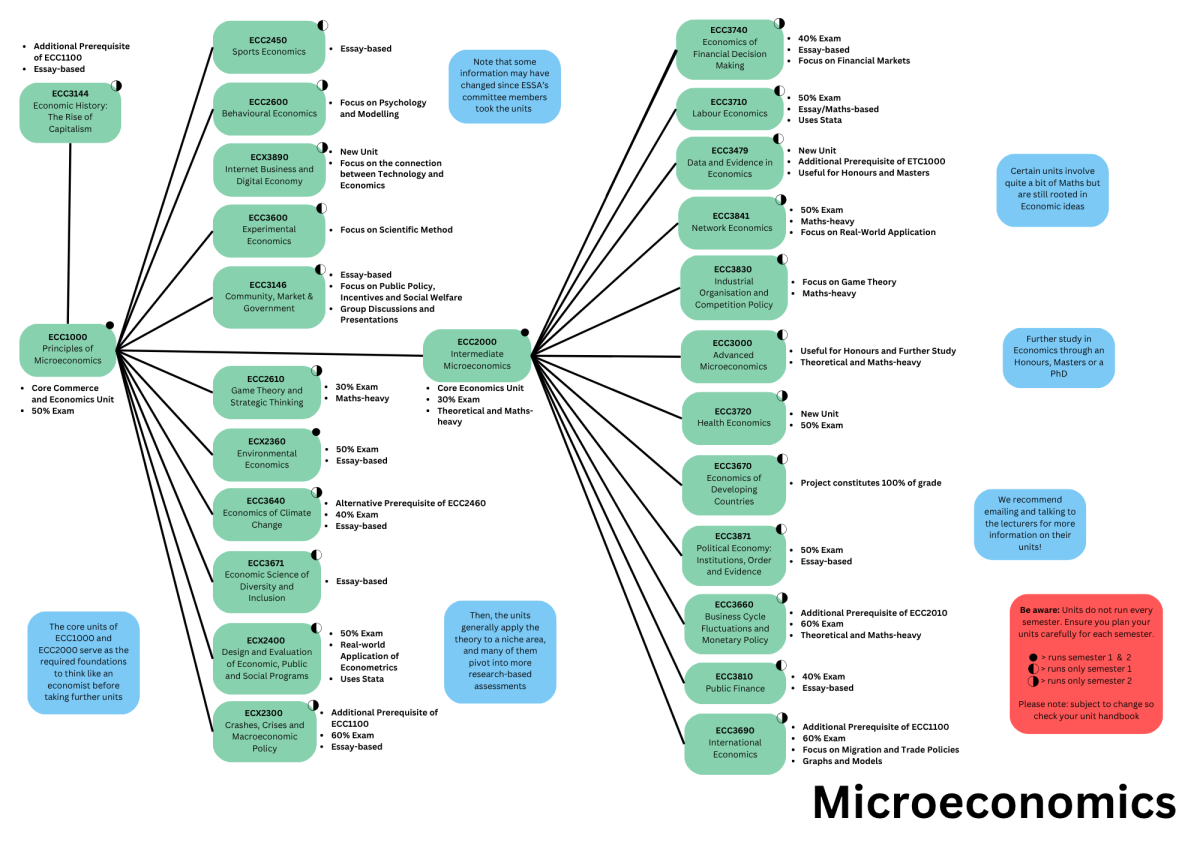
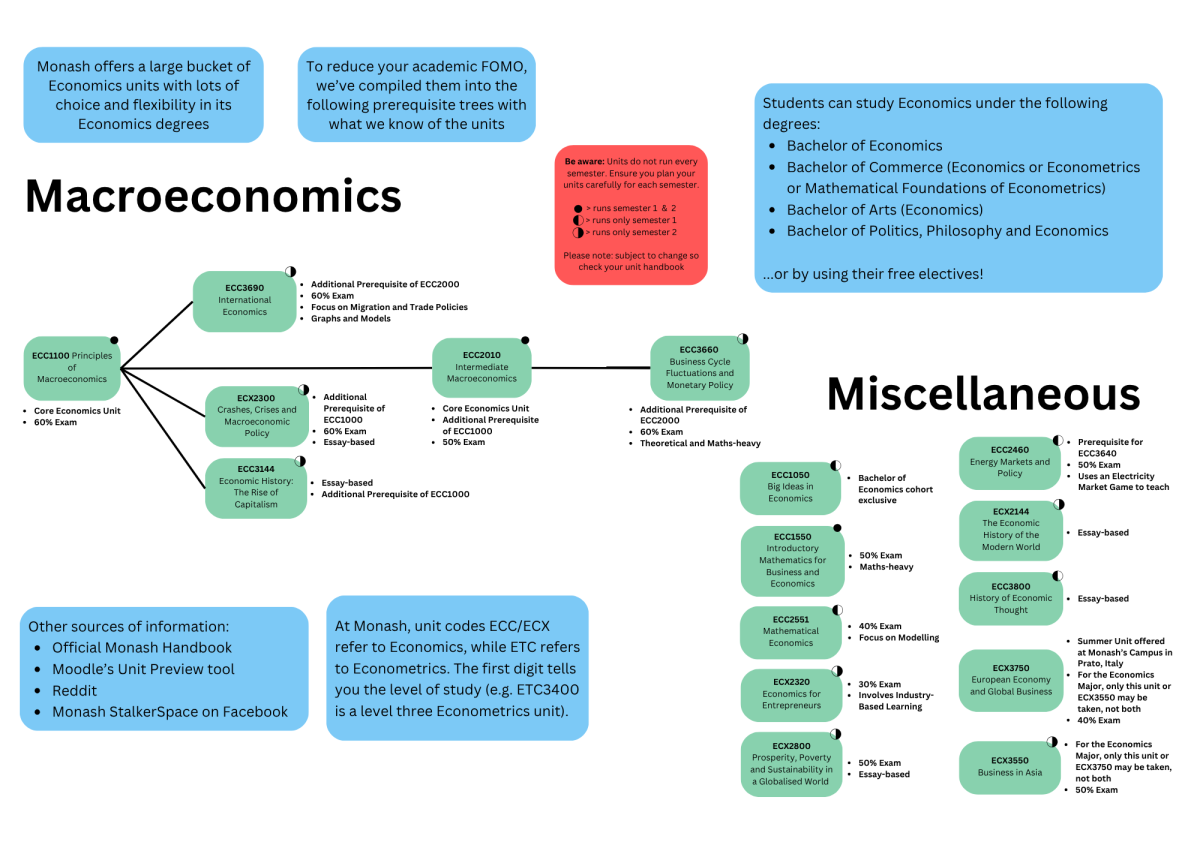
The Four Core Economics Units

Additional Economics Units (Clayton)

Economics Honours

What is Economics Honours?

The Economics Honours program is an additional year of study you can undertake after completing your bachelor’s degree. It is an opportunity for you to dive deeper into economics beyond what you’ve learnt in your bachelor’s degree. The course consists of two main components:

  • Coursework: Each semester, you will complete 3 coursework units. These are like advanced ‘extensions’ to economics units you’ve completed in your bachelor’s degree. There are some compulsory units, but also a wide range of elective choices covering the many areas of economics (e.g. public economics, trade…).
  • Research: One unit in each semester is reserved for the year-long honours research project. This project provides you the freedom to investigate an economic idea you’re interested in. You’ll have the opportunity to work closely with an experienced academic supervisor, who will provide guidance on how to develop your idea into a complete thesis.

Why pursue Economics Honours?

There are many reasons to take up the Honours year! Here are a few:

  • You can gain a deeper understanding of economics that you wouldn’t be able to in your bachelor’s degree. So, if you’re really interested in the concepts presented in your classes, consider taking an Honours.
  • You can investigate an economic question that you want to know the answer to. This could be something you saw in the news, or something in class that really caught your eye.
  • It opens up a lot of career opportunities that you wouldn’t have without an Honours degree! It is the first step to undertaking postgraduate studies where you can continue to investigate topics that intrigue you. It also provides you with a competitive edge in the job market. In fact, some graduate programs like the RBA prefer you to have an Honours degree!

How do you get in?

Since it is an intensive program, admission is competitive and all applicants will be ranked and selected based on academic record and candidate statement. Whilst meeting the minimum application criteria is essential, this does not guarantee admission into the Honours program. 

The application requirements are listed below:

  • Units: You’ll need to have completed the following:
      • ECC2000: Intermediate Microeconomics
      • ECC2010: Intermediate Macroeconomics 
      • ETC2410: Introductory Econometrics (students often forget about this one!)
      • At least four level three economics units (i.e., ECC3XXX units)
  • WAM: You’ll need to have a 70+ WAM in four level three economics units.
  • Maths: Be warned, the Honours program has a lot of maths! There are no units required for this, but if you want to prepare yourself, consider taking maths heavy units like ETC2440: Mathematics for Economics and Business, ECC2551 Mathematical economics, or have a look at the unit reviews and find those that have maths!

**Do note that the Honours program only offers a semester 1 intake.


Want to learn more?

If you’re interested, you can learn more through the following:

Claudio.Labanca@monash.edu 

Bachelor of Commerce and Bachelor of Economics

In our Subject Overview, we’ve structured the units based on an economics major under the Bachelor of Commerce. However, there is also the option to study economics within the double degree of Bachelor of Commerce and Bachelor of Economics.

Here, the requirements are a bit different. Within the Bachelor of Commerce, you will not be eligible to complete the same economics major. However, under the Bachelor of Economics, you will undertake foundation units and specialist studies.


Foundation units

  • ECC1000, ECC1100, ETC1000, ECC1050, ECC2000, ECC2010, ETC2410 and one of either ECC1550/MTH1020/MTH1030/MTH1035 

Specialisation (4 choices)

  • Economics and economic policy
  • Business analytics for economics
  • Macroeconomics and financial markets
  • Mathematical economics and econometrics

Each specialisation will have unique requirements, so we recommend referring to the handbook and course map pertaining to your chosen specialisation for the most up-to-date information.

Alternative ways to study Economics at Monash

Other degrees offering Economics

Besides the Bachelor of Commerce and Bachelor of Economics, you can also study economics under several other bachelor’s degrees. 

They include:

  • Bachelor of Arts;
  • Bachelor of Politics, Philosophy and Economics (PPE); and
  • Bachelor of Applied Data Science

Each degree has unique requirements, so we recommend referring to the handbook pertaining to your chosen degree for the most up-to-date information. 


Economics minor

Even if you don’t have enough space in your course for the full economics major, you can always get some economics in with a minor! This will allow you to get a taste of economics and understand key concepts, which will be useful in any field of commerce! For students following the 2026 handbook, you are required to do the following:

“You must complete any four undergraduate units (24 credit points) with the prefix ECC or ECX offered at the Clayton campus, with at least two units (12 credit points) at level 2 or 3.”

ECC1000 Principles of Microeconomics

Availability in 2026: Semester 1 and 2 (Clayton)

Mode of delivery: Applied sessions and workshops (S1 – blended; S2 – in-person)

Assessment structure: 20% Exercise, 30% Quiz, 50% Exam 

Topics covered: Supply and demand, market equilibrium, consumer behaviour, analysis of consumer decisions, optimal production, market structure, consumer choice, game theory and behavioural economics. 

How to do well: Success in this unit depends largely on a strong understanding of the graphs as most questions test diagram knowledge. When answering written questions, focus on explaining cause-and-effect relationships using precise definitions drawn from the textbook. Since the maths is not complex, focus on grasping each concept rather than concentrating on calculations. Finally, watch for subtle phrasing differences (e.g. movement along vs. shift of the demand curve).

Comments: Accessible to those with no economics background. Engage with Perusall and quizzes and build a strong grasp of the graphs. It’s an enjoyable intro to economics.

ECC1100 Principles of Macroeconomics

Availability in 2026: Semester 1 and 2 (Clayton)

Mode of delivery: Applied sessions and workshops (S1 – blended; S2 – in-person)

Assessment structure: In-class quiz 20%, Video Project 5%, Report (Group) Project 10%, Reflection Project 5%, Exam 60%

Topics covered: Inflation, unemployment, economic growth, aggregate demand, aggregate supply, role of monetary and fiscal policy in business cycles, current macroeconomic challenges. 

How to do well: A useful way to prepare for the exam is to practise explaining seminar slides (especially graphs/diagrams) in paragraph form. When constructing answers, follow this structure: definition → application → argument/counter-argument → graph reference → conclusion. To reinforce your understanding, create practice questions from seminar slides and tutorial material and review them weekly. It is also important to apply concepts to real-world scenarios by following current economic news.

Comments: A comprehensive overview of key macroeconomic principles and how different economic indicators interact. Some maths, but manageable for most students. A fascinating and broad introduction to macroeconomic theory and real-world applications.

ECC2000 Intermediate Microeconomics

Availability in 2026: Semester 1 and 2 (Clayton)

Mode of delivery: In-person workshops

Assessment structure: 30% Exercise, 40% Quiz/Test, 30% Exam

Topics covered: Consumption and production, theory of consumer choice, allocative efficiency, input pricing, market structures, and market failures.

How to do well: This unit takes many theoretical concepts from ECC1000, alongside some new ones, and quantifies them using functions and graphs. Being able to read these graphs to find correlations between different microeconomic concepts is highly important. If you are struggling with understanding a concept, don’t be hesitant to reach out to your tutors as there are plenty of consultations throughout the semester. To maximise your time during open-book assessments, it is useful to prepare a condensed version of the seminar/lecture slides, a table of formulas with relevant worked examples and a compilation of difficult workshop/tutorial questions.

Comments: This unit involves a plethora of calculus, such as partial derivatives, and linear equations with multiple parameters. However, regardless of your prior maths background, if you work smart and consistently, it is very possible to score highly. Also, stay in touch with your classmates throughout the unit as you will be able to help one another with the coursework.

ECC2010 Intermediate Macroeconomics

Availability in 2026: Semester 1 and 2 (Clayton)

Mode of delivery: In-person applied sessions and workshops

Assessment structure: 40% Quiz/Test, 10% Exercise, 50% Exam

Math vs. essay: Mathematically heavy unit. Involves short-answer responses.

Topics covered: Employment, productivity, growth, inflation, business cycles and macroeconomic policies (fiscal & monetary policies).

How to do well: This unit is a more advanced and considerably more mathematical version of ECC1100. It’s worth attending the workshops (which aren’t recorded) as they help you understand the content, develop your problem-solving skills, and figure out the markers’ expectations. Try to prepare notes for each topic as the semester progresses so that the workload doesn’t pile up at the end. If you can understand the interrelations between different concepts (e.g. how monetary policies affect the housing scheme), you will do well in this unit. Finally, don’t hesitate to stay back after your workshop if you are struggling with any concepts, as the teaching staff are very friendly and helpful.

Comments: This unit is structured with the intention that you view workshop slides and the textbook pre-workshop. During the workshop, the slides are explained more thoroughly. The tutorial is immediately after the workshop, where it focuses on questions related to the topics, which are thoroughly explained by the lecturer

ETC1000 Business and Economic Statistics

Availability in 2026: Semester 1 and 2 (Clayton)

Mode of delivery: In-person Tutorials

Assessment structure: Exercises 20%, 2 in-class tests (10% each), Group Project 20%, Exam 40%

Topics covered: Standardisation techniques, simple/multiple regression, nonlinear and categorical explanatory variables, time series data, probability theory, sampling data, estimators, confidence intervals, hypothesis testing, and variances. 

How to do well: This unit focuses on manipulating, interpreting, and evaluating datasets; balancing technical skills with clear, real-world explanations. The final exam is purely data analysis with no Excel or R involved, so it’s worth practising how to describe technical concepts in plain language. Reviewing past exam solutions is a good way to understand how to communicate findings accessibly. Many practice exams are provided, so make use of them to build confidence with the material.

Comments: This unit does not require any prior knowledge of Excel or R, though having some previous experience is highly advantageous. What you learn here will serve as the foundation for further units down the econometrics stream.

ECC1550 Introductory Mathematics for Business and Economics

Availability in 2026: Semester 1 & 2 (Clayton)

Mode of delivery: In-person applied sessions and workshop

Assessment structure: 50% quiz, 50% examination

Topics covered: Sets, relations, and functions, single-variable and multivariable differential calculus, leading up to formulating and solving unconstrained and constrained optimisation problems.

How to do well: Attending all the workshops and solving the questions provided will be key to success in the unit. The questions in the assignments are usually very similar to the ones discussed and basic practice should lead to success in the unit.

Comments: This unit requires you to be committed and attend all required workshops as content is built upon from one session to the next. The unit takes you through every concept with a practical aim of solving optimisation-based problems, such as prioritising items and production equipment in a factory or a farm, etc. The maths in the unit builds up over time and is similar to high school maths, starting with equations and ending with new concepts introduced in the unit. The lecturer is very helpful and will give you tons of guidance if asked. As an introductory unit, it does a good job of ensuring it can accommodate students with variable mathematical aptitudes.

ETC2410 Introductory Econometrics

Availability in 2026: Semester 1 & 2 (Clayton)

Mode of delivery: Tutorials

Assessment structure: 20% Group Assignment 1, 10% Group Assignment 2, 10% Tutorial Quiz & Participation, 60% Exam 

Topics covered: Properties of least squares estimators, hypothesis testing, the choice of appropriate functional form, dummy variables, issues around modelling survey data and the problems of serial correlation, heteroscedasticity and multicollinearity. 

How to do well: Each week builds on the previous one, so you need a strong grasp of early concepts (e.g. probability theory, matrix review). Group assignments are mainly done in R which makes it difficult to work together at once, so splitting tasks works well – but ensure you understand how to do all the parts. If any concepts feel unclear, attend the available consultations early as gaps in understanding compound and make later weeks significantly harder.

Comments: Assignments require producing full reports directly from R, so becoming comfortable with the software is essential. Although R is not required in the exam, understanding how to interpret its outputs is crucial for strong performance. Overall, the unit suits students who enjoy analytical, data‑driven work.

ECC1050 Big Ideas in Economics

Availability in 2026: Semester 1 (Clayton)

Mode of delivery: In-person applied sessions and workshops

Assessment structure: 55% quiz, 45% project

Topics covered: Key conceptual developments and advancements in economics, describing and applying tools that economists utilise to analyse and assess social and economic challenges.

Comments: This unit encourages students to apply the knowledge and skills learnt in an interactive and collaborative way. As a unit dedicated specifically for Bachelor of Economics students, it serves as a unique opportunity to build closer relationships within the cohort. In addition, there is ample opportunity to develop one’s communication skills, with emphasis placed on formulating both written and verbal economic arguments. Overall, this unit provides a great opportunity for students to gain a greater understanding of the tools that economists use to solve the problems that humanity faces.

*Note: None of our committee members have taken ECC1050: Big Ideas in Economics, so we have provided a heavily cut version of the handbook entry instead.

ECX2360 Environmental Economics

Availability in 2026: Semester 2 (Clayton)

Mode of delivery: In-person workshops

Assessment structure: 30% quiz/test, 20% written, 50% exam

Topics covered: Market failure, cost-benefit analysis, Coase theorem, environmental goods and different methods of valuation, and the relationship between the environment and economic development. 

How to do well: Be active in the weekly group discussions since the ideas discussed can be useful for the more theory-based assignments. For exam preparation, questions provided weekly are good practice despite being initially daunting.

Comments: This unit expands on the concepts that are taught in earlier units (ECC1000), and explores them in relation to the environment. There is a good mix of theory and application. In particular, the theory is interesting and thought-provoking, as there is no definitive answer due to the many unquantifiable aspects of the environment. This unit is challenging at first, but once understood is intuitive.

ECC2450 Sports Economics

Topics covered: Demand for and importance of sport, comparative advantage in sport, ticketing and pricing, and salary cap.

Availability in 2025: Semester 1 (Clayton)

How to do well: Start on the research assignment early and choose a topic you’re interested in. Make sure you understand the workshops as they cover all the required content. Familiarise yourself with the diagrams early.

Comments: Being able to choose a research topic of your own interest was great and there was a good link between the theory and practice.

ECC2460 Energy Markets and Policy

Availability in 2026: Semester 1 (Clayton)

Mode of delivery: In-person workshops

Assessment structure: 40% Exercise, 10% Quiz/ Test, 50% Exam

Topics covered: Energy markets, supply of energy, retail markets, fossil fuels and externalities, carbon pricing and renewable energy options.

How to do well: There is no textbook, so make sure you do the weekly readings and attend the workshops which go over content. This will also help with quizzes as they test critical thinking as well as basic math calculations. Active engagement in the energy game will help you with the assignments as well.

Comments: This unit has a weekly electricity trading game which allows you to apply what you have learnt in a fun and engaging way with your peers. I’d recommend this unit to people who like microeconomics and are interested in renewable energy/climate change/environmental policy.

ECX2400 Design and Evaluation of Economic, Public and Social Programs

Availability in 2026: Semester 1 (Clayton)

Mode of delivery: Workshops

Assessment structure: 5% Quiz/ Test, 25% Exercise, 20% Written, 50% Exam

Topics covered: Education, human migration, discrimination, health and making decisions in uncertainty/risk. 

How to do well: Be engaged! Some assessed tasks could be reattempted if we wanted to improve our mark, so put in the effort to try again where necessary.

Comments: The subject covers a lot of interesting topics, building upon ECC1000. There are a lot of in-semester tasks (presentation, peer assessments, essay, pre-class Moodle quiz), most of which are very quick and easy to do well in. However, be prepared to attend and work consistently throughout the semester.

ECC2551 Mathematical Economics

Availability in 2026: Semester 1 (Clayton)

Mode of delivery: No pre-recorded video material, readings or workshop activities. Three hour workshop consisting of lecture and discussion.

Assessment structure: 30% each for 2 Problem Exercises, 40% Exam

Topics covered: Finding equilibrium outcomes in strategic and non-strategic models, using notions of sets, relations and functions to model problems, using single/multi-variable calculus to solve optimisation problems, and analysing simple problems involving dynamic optimisation.

Comments: This unit involves interacting with tools to analyse mathematical models, and learning how to find the equilibrium outcome in both strategic and non-strategic contexts. It provides an opportunity to utilise mathematics for an economic analysis of human interactions within sub-fields like microeconomics, public finance and game theory. If you’re interested in learning how to use mathematics to construct and analyse models in various fields of economics, this unit is for you!

*Note: None of our committee members have taken ECC2551: Mathematical Economics, so we have provided a heavily cut version of the handbook entry instead.

ECX2300 Crashes, Crises and Macroeconomic Policy

Availability in 2026: Semester 2 (Clayton)

Mode of delivery: In-person workshops 

Assessment structure: 10% Exercise, 20% Presentation, 10% Exercise, 60% Exam

Topics covered: GFC, Coronavirus, the rise of inequality, automation and the labour market, liquidity trap, and stagnation.

How to do well: Engage with the material and participate actively in class and forum discussions. Make the most of the interactive classroom and consultations to ask questions. Make use of the readings to enhance your knowledge beyond the workshop material. This will help you stand out in assessments and the exam.

Comments: This is the kind of subject you can do to get ‘real world’ economic knowledge and be able to discuss economics with your friends! This unit doesn’t look at pure economic theory or maths, but rather helps you use your prior knowledge to understand key real-world economic events and issues. The classes and assessments encourage students to discuss the topics and examine them in more depth. The teaching team is also fantastic – they are very passionate, explain everything clearly, and are always happy to help!

ECX2144 The Economic History of the Modern World

Availability in 2026: Semester 2 (Clayton)

Mode of delivery: In-person applied sessions and workshops

Assessment structure: 70% Quiz/Test, 30% Presentation

Topics covered: Long-run pattern of development, leadership, and decline in the world economy; role of culture, institutions and the environment in shaping change.

Comments: This unit explores key turning points, trends, and events that have shaped the global economy since the Industrial Revolution. You will engage in debates about the world’s development, evaluating different views on the determinants of long-term economic and societal transformation.

ECC2600 Behavioural Economics

Availability in 2026: Semester 2 (Clayton)

Mode of delivery: In-person applied sessions and workshops

Assessment structure: 50% Quiz/Test, 15% Exercise, 35% Project

Topics covered: Psychology, experimental economics, expected utility, probability judgement, heuristics and biases, game theory, social preferences and norms. 

How to do well: The textbook gives very useful examples and practice questions. The workshops also cover everything needed to know, and understanding how to work through the examples given will be incredibly useful.

Comments: For those who want to see how psychology feeds into economic decision-making, this unit is for you. It’s a really fascinating look into rationality, and especially decision-making, and why people so often make suboptimal choices. With the many real-world applications provided throughout the unit, you will be able to take what you’ve learnt in this unit and apply it in your own life.

ECC2610 Game Theory and Strategic Thinking

Availability in 2026: Semester 2 (Clayton)

Mode of delivery: In-person workshops 

Assessment structure: 40% Exercise, 60% Quiz/Test

Topics covered: Sequential and simultaneous move games, bargaining games, coordination problems, mixed strategies, decision-making under uncertainty, repeated games, strategic moves and signalling games.

How to do well: Take your time to understand the intuition and strategic reasoning involved in the games, as you will need to apply and explain the concepts in various situations – rote learning is ineffective. The weekly exercises are crucial for learning and applying the concepts, as there are a lot of graphs and maths involved, with no practice tests or exams provided. If you have completed ECC3830, some of the content overlaps, which makes the unit a bit easier.

Comments: Game theory is a very interesting unit, and is great for anyone who likes strategy and is very analytical. The unit provides insight into how rational economic agents should behave in various games and its implications, and teaches you to think in a strategic, rational way. It also touches on behavioural economics and how some of the behaviour predicted by game theory is often completely different to how people actually behave in reality.

ECX2800 Prosperity, Poverty and Sustainability in a Globalised World

Availability in 2026: Semester 2 (Clayton)

Mode of delivery: In-person applied sessions, tutorials, and workshops 

Assessment structure: 15% Online Discussion Forum, Research Essay 35%, Exam 50%

Topics covered: Theories and models of development and poverty cycles, foreign aid, productivity and innovation, and climate change.

How to do well: Taking good, detailed notes during workshops throughout the semester is key to performing well in this unit. Additionally, the online ‘training’ quiz provides sufficient exam practice.

Comments: The content is engagingly presented by a fantastic lecturer and allows for good discussion of social issues. While the workload is moderately heavy during the semester, each topic is well-connected, making the exam study load lighter.

ECX2320 Economics for Entrepreneurs

Availability in 2026: Semester 2 (Clayton)

Mode of delivery: In-person workshops

Assessment structure: 10% Tutorial Participation, 20% Group Presentation, 30% Individual Assignment, 40% Group Capstone Project

Topics covered: Economics tools and analysis for establishing, sustaining or growing a business, price/demand determination, price sensitivity, economic costs and impact of business environment, the impact of industry-wide (e.g. market structure) and economy-wide (e.g. inflation) factors on business performance and competition strategy.

How to do well: To perform in this unit, you must be able to think through an economic lens. You should understand the economic behaviour of individual consumers and producers and how value is created. It is also crucial to understand the economic costs of production in the short and long-run, and price and output outcomes in different scenarios.

Comments: This is a great unit if you are starting or managing a business. It provides an economic lens through which you can analyse not only supply and demand, but also the wider environment that you will operate in.

ECC3600 Experimental Economics

Availability in 2026: Semester 1 (Clayton)

Mode of delivery: In-person workshops

Assessment structure: 20% quiz, 80% project

Topics covered: The history and classification of economic experiments, methodology of field and natural experiments, and a comparison between expected and observed outcomes in economic games.

How to do well: Becoming very familiar with the many new terms and classifications introduced in the first week goes a long way. Thoroughly read the case studies every week and understand how the scientific method is applied. Personally, I found reading research papers outside the provided cases very helpful.

Comments: Maths is not a huge part of this unit, but rather pops up in parts of each case study. Overall, it is an interesting, practical unit which focuses on research skills, equipping you with the knowledge on how to design, conduct, and apply economic experiments.

ECC3670 Economics of Developing Countries

Availability in 2026: Semester 1 (Clayton)

Mode of delivery: In-person workshops

Assessment structure: Project 100%

Topics covered: PPP, growth models, dual economy models and rural-urban migration, wage rigidity, inequality, poverty and undernutrition, gender, SDGs and climate change

How to do well: The learning structure has changed substantially to be focused on a large project which is self-driven research. Do the weekly readings as they are important for providing context to the topic you will want to engage in. If you are passionate about a topic, identify it early and work with teaching staff to build an essay question around it, as they have good insights and resources to reference. This is a fantastic unit to get insight into how economic research might look for you and allows you to demonstrate what you know about a given topic of economic development. This is a good unit to take in particular for those with a strong background in economics and a keen interest in development policy.

Comments: The teaching staff are very passionate; they are happy to discuss the content as well as their own research. It is a highly varied unit due to the broad scope of issues that affect developing countries, but the variety allows for canvassing of more issues that one can research in depth.

ECC3710 Labour Economics

Availability in 2026: Semester 1 (Clayton)

Mode of delivery: In-person workshops

Assessment structure: 20% Problem Sets, 30% Mid-Semester Test, 50% Exam

Topics covered: Labour demand and supply, wage differentials, labour market discrimination, education and human capital, and intergenerational income mobility.

How to do well: The unit begins with 4-5 lectures that outline familiar concepts regarding demand and supply models for a labour market, and equilibrium. The problem sets may require you to revisit notes for ECC2000. However, this will be an introduction for a lot of students into concepts in econometrics and coding in Stata. Whilst this might be conceptually and practically difficult, it is an important skill for post-graduate study as well as not making up a significant portion of the marking. Ensure you go to all workshops – they are not recorded and the teaching staff goes over how to work problems generally. The difficulty is also non-linear as the later weeks focus on novel models that one will not be familiar with. Some mathematical proficiency is required such as basic calculus and statistics, but greater understanding in this regard is very valuable.

Comments: There is a good mix of practical tools provided as well as conceptual models like the neo-classical labour model. To get the most out of this unit make sure you are able to connect the concepts you learn to the empirical evidence provided

ECC3810 Public Economics

Availability in 2026: Semester 1 (Clayton)

Mode of delivery: In-person workshops

Assessment structure: Quiz / Test 10%, Exercise 30%, Written 20%, Exam 40%

Topics covered: Market failures, types of government intervention, objectives of government intervention, taxation, theory of public sector growth, inequality, poverty and climate policy.

How to do well: This unit gets into a lot of the theoretical justification for and considerations of the government as an economic actor. The primary way this is done is through the tax – you will view this as an economic tool of redistribution, and see who “actually pays” when a tax is levied. This is done through mathematical problems, which rely on a solid understanding of ECC2000 type mathematics, but is not a difficult extension of it. Beyond the maths, a strong conceptual understanding is required to do well on the written component, as well as ensure high grades on the exam. Like many units, the ideas build week on week, so stay up to date with the readings and make notes on anything you find problematic – this is the surest way to get clarification if you misunderstand.

Comments: A strong student is able to connect what they are learning in the mathematical models to the broader policy. Make sure you always look for the bigger picture, as this will help for the written task and exam especially where there may be high mark questions requiring case studies as evidence.

ECC3830 Industrial Organisation and Regulation

Availability in 2026: Semester 1 (Clayton)

Mode of delivery: In-person workshops

Assessment structure: Quiz / Test 40%, Exercise 20%, Presentation 20%, Project 20%

Topics covered: Competition economics and market failure, game theory, monopolies, oligopolies, mergers, collusion and vertical integration, antitrust policy

How to do well: Make sure to keep up with weekly seminars and complete all tutorial questions (this helps particularly with the assignment and final exam). Utilise consultations and don’t be afraid to ask questions about the assignments if you’re stuck. Also, make sure to start on the assignments early – they can be tricky to wrap your head around sometimes! 

Comments: IO is a great unit if you’re interested in competition economics, and provides a strong foundation for understanding and analysing real-world competition issues. IO draws and builds on earlier microeconomic principles by applying them to specific competition scenarios. While the unit is quite mathematical, don’t be put off – the maths is intuitive and complements the theory taught in seminars. Though the unit is relatively content heavy, it is a very rewarding unit with lots of support and resources available. Overall, this unit provides a great strategic framework for analysing economic issues and policy.

ECC3871 Political Economy: Institutions, Order, and Evidence

Availability in 2026: Semester 1 (Clayton)

Mode of delivery: In-person workshops

Assessment structure: 50% exercises, 50% examination

Topics covered: The theory and empirics of voting, violence and political order, governance and collective action, elites and theories of the state, institutions and growth, institutional change and path dependence. 

How to do well: To better understand the readings in this unit, pay close attention to the relationship between the reading on hand and readings from all other weeks. You should focus on the differences in methodology. Try taking a step back after reading each paper to analyse where the paper fits into the key questions that the unit aims to answer. Furthermore, it’s also important to brush up on some econometrics, as some papers will require it. There aren’t any calculations involved in this unit, but there are some graphical and mathematical models.

Comments: This unit will be great for those who are interested in the kinds of historical factors that have influenced the structure of the political and economic systems we have today. It is also good for people who like to study issues rigorously, as it deals extensively with theories of causation.

ECC3000 Advanced Microeconomics

Availability in 2026: Semester 1 (Clayton)

Mode of delivery: In-person workshops

Assessment structure: 30% exercise, 70% quiz

Topics covered: Core microeconomic theories and their applications, theories of decision-making in strategic and non-strategic contexts, market structures, and reasons for market failures including externalities and asymmetric information.

Comments: This unit enables students to gain a thorough understanding of modern microeconomic principles and theories, preparing them for further study or careers in economics, finance, and policy analysis. It is strongly mathematical, using concepts from set theory to construct axiomatic proofs of economic ideas.This unit will equip you with the technical skills needed to pursue an Honours in Economics and Masters level research!

*Note: None of our committee members have taken ECC3000: Advanced Microeconomics, so we have provided a heavily cut version of the handbook entry instead.

ECC3800 History of Economic Thought

Availability in 2026: Semester 1 (Clayton)

Mode of delivery: In-person tutorials

Assessment structure: 30% in-class quizzes (6 quizzes, 5% each), 20% video assignment, 20% essay, 30% final take-home assignment

Topics covered: Classical economists (e.g. Smith, Ricardo, Malthus), Keynesian economics, monetarist economics (e.g. Friedman), influential female economists (e.g. Paley, Ostrom), sustainability, income inequality, intergenerational disadvantage, globalisation and trade.

How to do well: Keep up with weekly readings and participate in class discussions (it’s a small, supportive class so don’t be shy!).

Comments: An incredibly enjoyable unit which teaches very different content to the average economics unit. Doing this unit gives you an appreciation of how we arrived at all the current theories taught in other classes. The unit explores the contextual history of all foundational economists, which helps you understand how and why economics has evolved the way it has. This unit requires significant critical thinking, essay writing, and the ability to synthesise and apply readings; a small and intimate class size means participation in class is really important and you’ll gain a lot by doing the readings and discussing them with everyone.

ECC3146 Community, Market and Government

Availability in 2026: Semester 1 (Clayton)

Mode of delivery: In-person workshops

Assessment structure: 30% exercises, 50% quiz, 20% presentation

Topics covered: Social insurance and redistribution, public health outcomes, effectiveness of law enforcement, governance of common pool resources, fair trade and consumer activism, public policy and charitable giving, the relationship between public policies, social interaction and public health outcomes, social influence and polarisation, market failure and government failure.

How to do well: There is no textbook, so it is important to do the weekly readings as class discussions each week revolve around the concepts examined in each reading. As class discussion is a key component of the unit, students are able to really engage with the topics. To get the most out of this unit, always come to class prepared.

Comments: This unit is not maths-heavy. If you’re interested in how economic concepts you’ve learnt previously can be reflected in the community, this is the unit for you.

ECC3671 Economic Science of Diversity and Inclusion

Availability in 2026: Semester 1 (Clayton)

Mode of delivery:  In-person workshops 

Assessment structure: Quiz / Test 60%, Project 40%

Topics covered: The economic value of diversity and inclusion in modern workplaces, workplace barriers, and success and failure of interventions.

How to do well: This unit explores the economics of workplace diversity and inclusion, addressing both theoretical and practical aspects of the topic. By examining diversity and inclusion, as well as the effectiveness of various interventions, you are tasked to come up with solutions to break these barriers. The solutions that students come up with will be very applicable in the workplace as well. If you want to practice your analytical and problem-solving skills, this unit is for you!

*Note: None of our committee members have taken ECC3671 –  Economic Science of Diversity and Inclusion so we have provided a heavily cut version of the handbook entry instead

ECC3479 Data and Evidence in Economics

Availability in 2026: Semester 1 (Clayton)

Mode of delivery: In-person workshops

Assessment structure: Project 60%, Quiz / Test 40%

Topics covered: Research design, selection of conceptual and empirical methods, communication of findings, critical thought and analysis

How to do well: This unit is an ideal precursor to later study and even post-graduate level research. By learning practical tools to appropriately answer economic questions, you become a proficient economic analyst. Some experience in statistical analysis and experimental design will be beneficial, but a genuine curiosity in economic academia and the will to answer pertinent problems is crucial.

Comments: This unit enables students to demonstrate and convey economic concepts in a pragmatic manner. A strong, analytical approach to examining the empirical basis of economics is sought in this unit.

*Note: None of our committee members have taken ECC3479: Data and Evidence in Economics, so we have provided a heavily cut version of the handbook entry instead.

ECC3660 Business Cycle Fluctuations and Monetary Policy

Availability in 2026: Semester 2 (Clayton)

Mode of delivery: In-person workshops

Assessment structure: 20% exercises, 20% quiz, 60% examination

Topics covered: Advanced macroeconomics (AD-AS model), monetary policy implementation, efficiency and central bank credibility, liquidity trap and unconventional monetary policy (e.g. forward guidance and quantitative easing).

How to do well: This unit has a lot of equations, but the important thing is to

understand what they mean. Make sure to define each variable and understand why it is there. Drawing graphs also helps a lot! There are a few hard concepts in the unit, so take some time to understand them.

Comments: The highlight of this unit was coming to understand what the RBA does, and learning about the unprecedented evolution of monetary policy following the GFC. It is quite a difficult unit but this makes it even more rewarding once you understand what is going on.

ECC3690 International Economics

Availability in 2026: Semester 2 (Clayton)

Mode of delivery: In-person seminars and tutorials

Assessment structure: Demonstration 10%, Written 10%, Quiz / Test 20%, Exam 60%

Topics covered: International trade, Ricardian model of trade, Specific Factors model, Heckscher-Ohlin model, gains from trade, foreign exchange rates, and national and international accounts.

How to do well: Stay on top of the weekly seminars, as new content builds on previous weeks and are invaluable for solving tutorial problems. Make sure you understand the basic assumptions of each model, as comparisons between models are often drawn. Also, the practice questions were not compulsory, but were a great learning resource for the unit. A large portion of the unit centres around the ideas of gains that arise from trade, and how we can demonstrate that via comparative advantage. The astute student will be able to show this mathematically, and link it to broader policy discussion.

Comments: This unit was well organised, and the weeks of content flowed intuitively. It starts from traditional classical trade models and then ends in modern application. The teaching team are incredibly passionate and value your feedback so attendance is very important. 

ECC3841 Network Economics

Availability in 2026: Semester 2 (Clayton)

Mode of delivery: In-person workshops

Assessment structure: 35% exercises, 15% presentation, 50% examination

Topics covered: Network formation, peer effects in a range of applications (e.g. education, crime, development, labour market), physical networks, contagion and diffusion (e.g. COVID-19).

How to do well: The unit has a mix of theory and application, with a lot of equations in both. Make sure you understand what these equations mean (e.g. what relationship does each coefficient represent?). With the applications, focus on the ideas they are capturing (e.g. same gender peer effects) rather than exact regression results! It will be these ideas that exam questions draw on.

Comments: This unit had the most real-world application of any unit I’ve done. Every week centres around exploring how interactions between people affect outcomes in different policy areas. The highlights for me were exploring how contagions such as COVID-19 spread throughout a population, and how criminal networks can be used to better police crime.

ECC3640 Economics of Climate Change

Availability in 2026: Semester 2 (Clayton)

Mode of delivery: In-person workshops

Assessment structure: Quiz / Test 6%, Exercise 28%, Written 26%, Exam 40%

Topics covered: Impacts, costs and damages of climate change, measuring costs and benefits of climate policy, international agreements (e.g. Kyoto, Paris) and climate policy in Australia

How to do well: Get involved and ask questions in class discussions! This really helps you understand concepts from the readings and workshops at a deeper level. Draw a lot of graphs to get comfortable with them. This is the perfect unit for a multi-disciplinarian with a science degree, as it allows one to approach policy-related questions from a practical perspective regarding actual data and economic considerations. Being a very pertinent issue, come to the table with big ideas and leave with robust cost-benefit analysis tools to evaluate them.

*Note: None of our committee members have taken ECC3640 – Economics of Climate Change, so we have provided a heavily cut version of the handbook entry instead.

ECC3740 Economics of Financial Decision Making

Availability in 2026: Semester 2 (Clayton)

Mode of delivery: In-person workshops

Assessment structure: Written 40%, Presentation 20%, Exam 40%

Topics covered: Household and consumer finance, the role of debt and credit in the economy, firm investment, implications of financial decision making, causal inference in financial economics, risk preferences, and portfolio choice.

How to do well: Become integrated into the role of financial markets and intermediation in the modern economy. This has multiple effects. For one, it allows you to internalise and rationalise how consumers and firms invest, but also the trade-off between risk and return more generally. Financing tools are an important part of public budget, development economics, and investing, and this unit is highly versatile therefore. Some understanding of financial mathematics is required.

*Note: None of our committee members have taken ECC3740 – Economics of Financial Decision Making, so we have provided a heavily cut version of the handbook entry instead

ECC3144 Economic History: The Rise of Capitalism

Availability in 2026: Semester 2 (Clayton)

Mode of delivery: In-person applied sessions and workshops

Assessment structure: 30% presentation, 70% quiz

Topics covered: Sources of long-run economic change, the industrial revolution, the “Great Divergence”, the economic rise of the US, the processes promoting globalisation, and the origins of Australia’s prosperity.

Comments: This unit focuses on the historical evolution of the modern economy, focusing on the processes that led to the emergence of capitalism. There will be a major emphasis on understanding the dialogue between economic history and historical sociology to shed light on social phenomena. You will also analyse recent research papers on economic history and engage in debates on the interaction between economic institutions and social structures.

*Note: None of our committee members have taken ECC3144: Economic History: The Rise of Capitalism, so we have provided a heavily cut version of the handbook entry instead.

ECC3720 Health Economics

Availability in 2026: Semester 2 (Clayton)

Mode of delivery: In-person applied sessions and workshops

Assessment structure: Performance 15%, Project 35%, Exam 50%

Topics covered: Health-related economic decision-making, healthcare markets, market failures, health insurance services, government interventions into healthcare, impact of inequalities.

How to do well: This is a new unit that analyses the different economic problems associated with healthcare. This includes neo-classical market failures such as healthcare as a source of strong positive externalities, and adverse selection. However, considering that this has a significant research focus, connecting these market failures to broader policy discussion is crucial. Additionally, there is a strong focus in this unit on interactivity, so come to class fully prepared!

*Note: None of our committee members have taken ECC3720 – Health Economics, so we have provided a heavily cut version of the handbook entry instead.

ECX3890 Internet Business and Digital Economy

Availability in 2026: Semester 2 (Clayton)

Mode of delivery: In-person workshops

Assessment structure: 50% written assessment, 20% presentation, 30% project

Topics covered: The economics of startups, online advertising (e.g. Facebook and Google), the impact of social networks on content creation and sharing on social media, potential misuse of market power by large digital platforms, consumer privacy, and the role of economics in informing the future development of the internet.

Comments: This unit should be intriguing for anyone interested in the economics of online businesses, and the regulatory challenges created by digital markets. It will introduce you to the process of designing online business models, and discuss how data and digital interactions shape consumer behaviour. Overall, it would be a great unit for those  interested in the intersection of economics, business strategy, and digital technologies in today’s markets.

*Note: None of our committee members have taken ECX3890: Internet Business and Digital Economy, so we have provided a heavily cut version of the handbook entry instead.

ECX3550 Business in Asia

Availability in 2026: Semester 2 (Clayton)

[*Note: There are various offerings of this unit across the Clayton, Caulfield, and Peninsula campuses. The information contained in this Subject Overview only pertains to the Clayton offering, so we recommend checking out the handbook for information on other offerings.]

Mode of delivery: In-person and online seminars and tutorials

Assessment structure: 20% presentation, 80% project

Topics covered: The development state of selected Asian economies; the stages, causes and consequences of their economic growth; the processes and outcomes of economic policy reforms.

Comments: This unit focuses on the recent evolution of Asian economies, and how businesses operate within diverse economic contexts across Asia. If you are keen to explore the interplay between economic policy, growth, and business practices in one of the world’s most economically dynamic regions, this would be a great unit for you.

*Note: None of our committee members have taken ECX3550: Business in Asia, so we have provided a heavily cut version of the handbook entry instead.

ECX3750 European Economy and Global Business

Availability in 2026: Summer Semester A (Prato, Italy)

Mode of delivery: In-person classes; includes field trips

Assessment structure: 20% quiz, 20% written assessment, 20% project, 40% examination

Topics covered: The economic and business challenges for actors in the EU and European markets, their interactions with the global economy, and how history, business opportunities, and economic policy affect the business strategy of market participants.

How to do well: Understand the political and socio-cultural nuances of the EU members and how these may influence and affect the relationships and operations of businesses that exist in Europe. Be informed about current economic events in the EU and understand their impact on businesses.

Comments: This would be an excellent subject choice for those wishing to do a summer intensive abroad while still engaging in economics. The unit focuses on understanding the historical backdrop influencing the current state of the EU and the monetary union, enabling you to appreciate the complex economic challenges navigated by European businesses and countries. It also helps students develop a strategic viewpoint on issues contended with by European multinationals.

If you have an interest in working with or in European companies in the future, and are intrigued by the socio-cultural and political forces in Europe and their impact on businesses and economic relations worldwide, this would be a great unit to study.

*Note: None of our committee members have taken ECX3750: European Economy and Global Business, so we have provided a heavily cut version of the handbook entry instead.